cn256_IntegersAndDivision_2026-03-24
[!links] Parent: COMP 256 MOCCOMP 256 MOC\[!links\] \_Home MOC References LaTeX Reference Class Notes cn256_IntegersAndDivision_2026-03-24 Midterm COMP 256 Midterm Studyguide
Integers and Division
New Notation
Divides & Not-Divides
Definitions
If $a$ and $b$ are integers with $a \neq 0$, we say that $a$ divides $b$ if there is an integer $c$ such that $b = ac$. When $a$ divides $b$ we say that $a$ is a "factor of" $b$ and that $b$ is a "multiple of" $a$.
Divides Operator $$3 | 12$$
- To specify when an integer evenly divides another integer
- Read a "3 divides 12"
Not-divides operator $$3 \nmid 12$$
- To specify when an integer does not evenly divide another integer
- Read a "5 does not divide 12"
Example Uses
Determine $3 \mid 7$ $3 \nmid 7$ because $\frac{7}{3}$ is not an integer
Determine $3 \mid 12$ $3 \mid 12$ because $\frac{12}{3} = 4$
Theorem
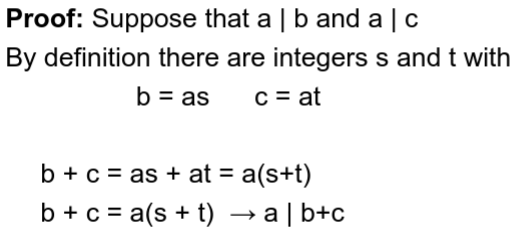
- If $a \mid b$ and $a \mid c$, then $a \mid (b+c)$
- Example: if $5 \mid 25$ and $5 \mid 30$, then $5 \mid (25+30)$
- Example: if $5 \mid 25$ and $5 \mid 30$, then $5 \mid (25+30)$
- If $a \mid b$, then $a \mid bc$ for all integers $c$
- Example: if $5 \mid 25$, then $5 \mid 25*c$ for all ints c
- If $a \mid b$ and $b \mid c$, then $a \mid c$
The Division "Algorithm"
Let $a$ be an integer and $d$ be a positive integer. Then there are unique integers $q$ and $r$, with $0 \le r \lt d$, such that $a = dq+r$
$d$ is divisor, $a$ is dividend $q$ is quotient, $r$ is remainder
- We then define two operators:
- $q = a \mid d$
- $r = a \mod d$
Examples
Example 1
What are quotient and remainder when $101$ is divided by $11$?
[!Answer]+ $101 = 11 \cdot 9 + 2$
- quotient is $9$ ($2 = 101 \mid 11$)
- remainder is $2$ ($2 = 101 \mod 11$)
Example 2
What are quotient and remainder when $-11$ is divides by 3?
[!Answer] $-11 = 3(-4) + 1$
- quotient is $-4$ ($-4 = -11 \mid 3$)
- remainder is 1 ($1 = -11 \mod 3$)
But $-11 = 3(-3)-2$, why not?
- Because $r = (-2)$ does not satisfy $0 \le r \lt 3$
Prime / Composite Numbers
- A positive integer $p$ is prime if the only positive factors of $p$ are $1$ and $p$
- If there are any other factors, it is composite
- Note that $1$ is not prime or composite, it's in its own class
- An integer $n$ is composite if and only if there exists an integer $a$ such that $a \mid n$ and $1 \lt a \lt n$
Fundamental Theorem of Arithmetic
- Every positive integer greater than $1$ can be uniquely written as a prime or as the product of two or more primes where the prime factors are written in order of non-decreasing size
Composite Factors
- If $n$ is a composite integer, then $n$ has a prime divisor less than or equal to the square root of $n$
- Strong inductive proof using the following logic:
- Since n is composite, it has a factor a such that $1 \lt a \lt n$
- Thus, n = ab, where a and b are positive integers greater than 1
- Either $a \le \sqrt{n}$ or $b \le \sqrt{n}$ (Otherwise, $ab \gt \sqrt{n} \cdot \sqrt{n} \gt n$)
- Thus, n has a divisor not exceeding n
- This divisor is either prime or a composite
- If the latter, then it has a prime factor
- In either case, n has a prime factor less than n
Showing a number is prime
Show that $113$ is prime
[!Answer]+
- The only prime factors less then $\sqrt{113} = 10.63 \text{ are } 2,3,4, \text{ and } 7$
- Neither of these divide $113$ evenly
- Thus, by the fundamental theorem of arithmetic, $113$ must be prime
Showing a number is composite
Show that $899$ is prime
[!Answer]+
- Divide $899$ by successively larger primes (up to $\sqrt{899} = 29.98$), starting with $2$
- We find that $29$ and $31$ divide $899$
Primes are infinite
-
Theorem (by Euclid): There are infinitely many prime numbers
-
Proof my contradiction
-
Assume there are a finite number of primes
-
List them as follows: $p_1, p_2, ..., p_n$
-
Consider the number $q = p_1 p_2 ... p_n + 1$
- This number is not divisible by any of the listed primes
- If we divided $p_i$ into $q$, there would result a remainder of $1$
- We must conclude that $q$ is a prime number, not among the primes listed above.
- This contradicts our assumption taht all primes are in the list $p_1, 0_2, ..., p_n$
- This number is not divisible by any of the listed primes
LCM, GCD
GCD - Greatest Common Divisor
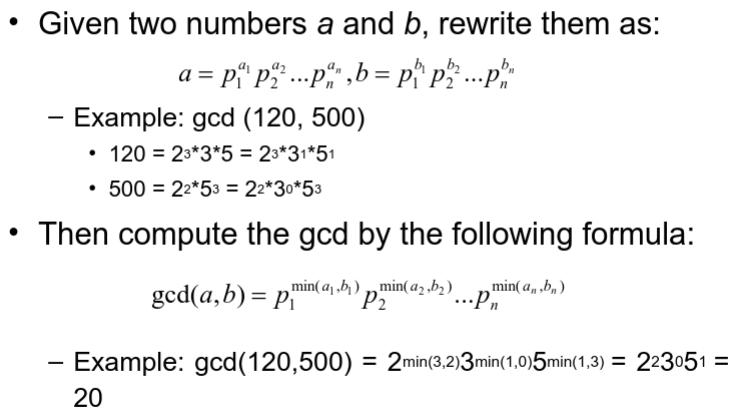
The greatest common divisor of two integers $a$ and $b$ is the largest integer $d$ such that $d \mid a$ and $d \mid b$
- Denoted by $\gcd(a,b)$
Examples
- $\gcd(24,36) = 12$
- $\gcd(17,22) = 1$
- $\gcd(100,17) = 1$
Relative Primes
- Two numbers are relatively prime if they don't have any common factors (other than 1)
- Rephrased: $a$ and $b$ are relatively prime if $\gcd(25,39) = 1$
- $\gcd(25,39) = 1$ so $25$ and $39$ are relatively prime
More on GCDs
LCM - Least Common Multiple
- Denoted by $\operatorname{lcm}(a,b)$
- $\operatorname{lcm}(a,b) = p_1^{\max(a_1,b_1)} p_2^{\max(a_2,b_2)} ... p_n^{\max(a_n,b_n)}$
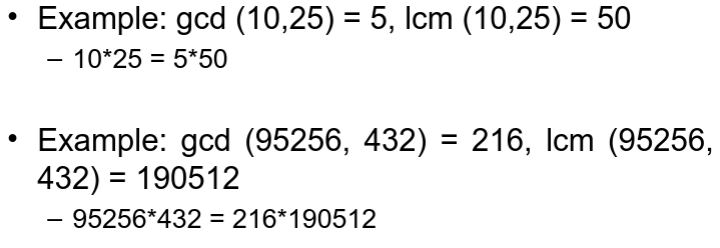
- Example: $\operatorname{lcm}(10,25) = 50$
LCM and GCD theorem
- Let $a$ and $b$ be positive integers. Then $a \cdot b = \gcd(a,b) \cdot \operatorname{lcm}(a,b)$
Pseudo-random Numbers
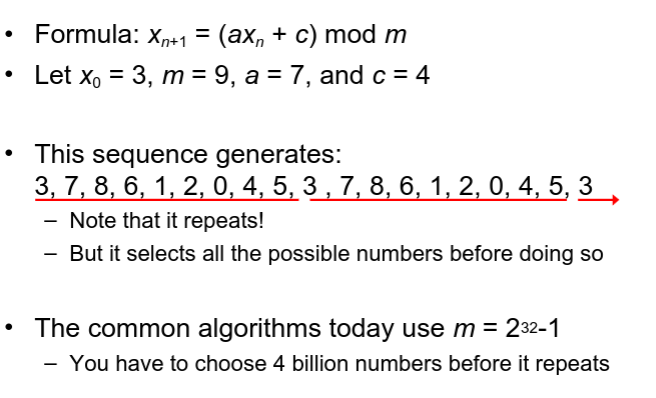
- Computers cannot generate truly random numbers!
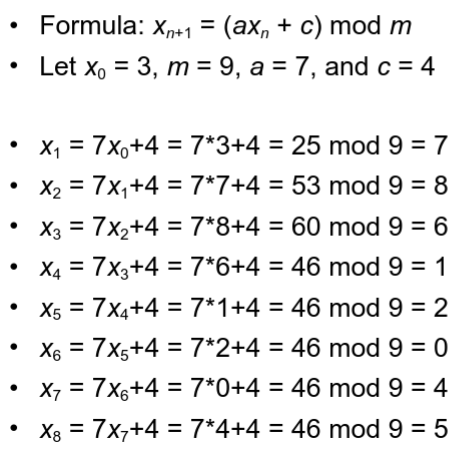
- Algoriths for "random" numbers: choose 4 integers
- Seed $x_0$: starting value
- Modulus $m$: maximum possible value
- Multiplier $a$: such that $2 \le a \lt m$
- Increment $c$: between $0$ and $m$
- Formula: $x_{n+1} = (ax_n + x) \mod m$
The Caesar Cipher
- Julius Caesar used this to encrypt messages
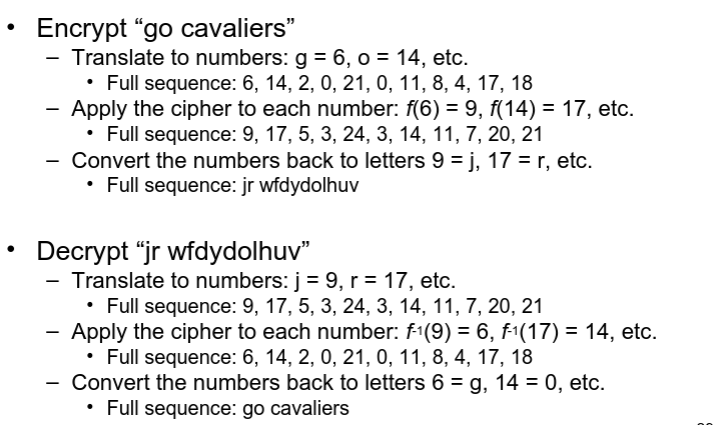
- A function $f$ to encrypt a letter is defined as: $f(p) = (p+3) \mod 26$
- Where $p$ is a letter ($0$ is $A$, $1$ is $B$, $25$ is $Z$, etc...)
- Decryption: $f^{-1}(p) = (p-3) \mod 26$
- This is called a substitution cipher
- You are substituting one letter with another.
- You are substituting one letter with another.
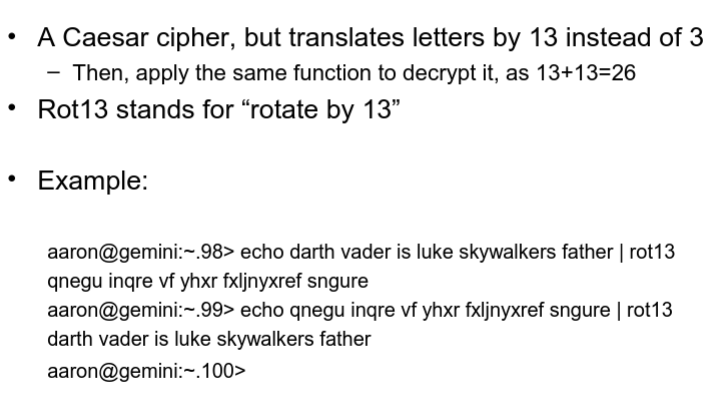
Rot13 encoding